

Why Big Brand Rebrands Keep Failing and What Small Business Owners Should Do Instead
By Cap Puckhaber, Reno, Nevada
Jaguar ditched 90 years of heritage for a rebrand that left its most loyal fans confused and angry. Cracker Barrel stripped out the rustic visual cues its customers had loved for decades, and the backlash came fast and loud. Southwest Airlines abandoned the exact positioning that had made it different from every other carrier it competed against for 50 years. These aren’t obscure companies making amateur mistakes. These are billion-dollar brands with entire marketing departments, and they are still getting this wrong in a spectacular and very public way.
There is a pattern here that Cap Puckhaber has watched play out with big brands and small ones alike. The moment a business starts confusing looking different with actually being different, it starts bleeding trust. Because trust, once broken by a brand change that feels wrong to the customer, is genuinely hard to earn back. The good news is that small business owners have a structural advantage in this environment that most of them don’t realize they’re sitting on.
The Billion-Dollar Branding Mistakes Happening Right Now
Research into recent high-profile brand changes shows that rebrands fail in three predictable ways. Brands change too much too fast, breaking the recognition customers rely on, solve a design problem when they actually have a business problem, and ignore what their existing customers think before spending enormous sums on a new visual identity. The companies that recover fastest share one consistent behavior: they listen to customer backlash within days and reverse course quickly.
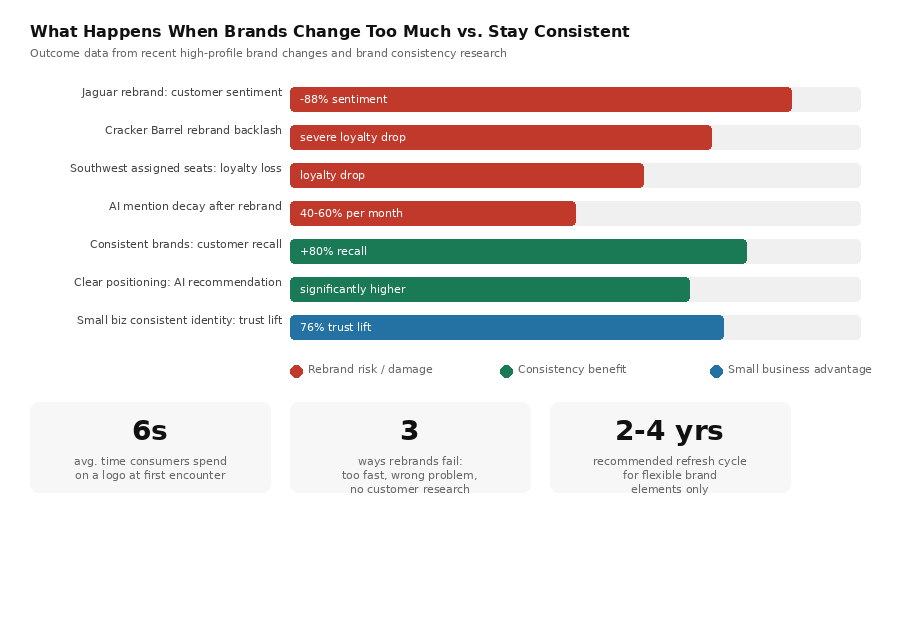
But there is a newer risk that applies directly to how small businesses get discovered. Brands that blur their positioning or introduce inconsistent messaging are seeing a 40 to 60 percent monthly decay in how often AI-powered search tools recommend them. AI systems don’t just index brand assets. They infer meaning from the clarity and consistency of what a brand says and stands for. When that clarity disappears, so does the brand’s visibility in an increasingly AI-mediated search environment.
What the Data Shows
The numbers below capture the cost of getting this wrong. The chart below shows the upside when small businesses get it right.
What Happens When Brands Change Too Much vs. Stay Consistent
Outcome data from recent high-profile brand changes and brand consistency research
What Brand Identity Actually Means for a Small Business
Brand identity is not your logo. It’s not your color palette. It’s not even your tagline, though those things matter. Brand identity is the full collection of signals your business sends every time a potential customer encounters you, whether that’s your website, your Google Business Profile, a social media post, an invoice, or the way you answer the phone. All of those signals either build or erode a consistent impression in the customer’s mind.
The mistake I see small business owners make constantly is treating brand identity as a one-time creative project. They hire someone to design a logo, pick some colors, and consider the job done. Because branding is not a deliverable you complete and move on from, it’s an ongoing discipline of consistency that compounds over time. A single inconsistency, like using one logo version on your website and a different one on your business card, quietly chips away at the recognition you’re trying to build.
Why Consistency Is Worth More Than Creativity
There is a useful way to think about brand consistency. Most small business owners who win on brand limit themselves to one or two primary colors and maintain rigid consistency guidelines across every customer touchpoint. The businesses that do this well don’t necessarily have the most creative brands. They have the most recognizable ones. Customers who can identify your business instantly, without reading your name, are far more likely to trust you, return to you, and refer you to others.
Since most consumers discover small businesses for the first time through mobile search, map apps, or social media, the first impression your branding makes is often on a screen you don’t control. If those touchpoints don’t reflect a consistent identity, you create confusion before someone even contacts you. Confusion is the enemy of conversion. So consistency isn’t just a design principle. It’s a direct business performance driver.
The Branding Mistake I Made When I Launched Black Diamond
When I built Black Diamond Marketing Solutions, I went through two versions of the brand in the first eight months. The first version looked clean and professional, but it didn’t feel like anything. There was no point of view baked into it. No clear signal about who we were for or what we stood against. Clients couldn’t describe us to other people, and that’s a problem because word of mouth is how most small agencies grow.
The second iteration forced me to answer harder questions. What does Black Diamond stand against? Are there clients that aren’t a good fit? Is there one thing we want every person to feel after working with us? Those answers shaped everything from the visual identity down to the language in our proposal templates. Because a brand that can answer the question of what it stands against is far more memorable than one that just describes what it does.
This is the lesson that the big rebrand failures of the last two years keep demonstrating in painfully expensive ways. Great brands don’t just stand for something. They fight against something. Jaguar had been fighting against boring, safe automotive design for decades. When the rebrand erased that tension, there was nothing left for customers to hold onto. Southwest had been fighting against the high fees and impersonal service of legacy airlines since the 1970s. When it adopted assigned seating, it became the thing it had spent 50 years differentiating against.
The Question Small Business Owners Skip
Most small business branding advice tells you to define your mission, pick your colors, and write a brand statement. That is fine as far as it goes. But the question that actually makes brands memorable is harder: what do you refuse to be? Your brand is defined as much by what you reject as by what you claim. A plumber who positions specifically as the plumber who shows up on time is staking a claim against a real, specific frustration that customers have. A marketing agency that refuses to work with clients who want to spray and pray with a $500 ad budget is defining itself by what it stands against.
When you can articulate that clearly, customers can repeat it. They can tell their neighbors, their business partners, their social network. That repeatability is the actual goal of brand identity, and it’s the part that Canva templates and generic logo generators can’t give you.
How AI Is Changing What Brand Clarity Means
The AI visibility risk deserves more attention than most small business owners are giving it right now. When someone asks an AI assistant to recommend a local marketing agency, a contractor, or a restaurant, the AI doesn’t just pull from a directory. It infers meaning from the totality of what it finds associated with a brand name, including website copy, social media tone, review language, business description consistency across platforms, and the clarity of positioning signals across all of those sources.
A brand that sounds different on its website than it does on its Google Business Profile than it does on its Facebook page is sending incoherent signals. AI systems, much like human customers, respond to that incoherence by defaulting to a competitor whose signals are clearer. So the brands that benefit most from AI-powered discovery are not necessarily the biggest or the most creative. They are the most consistent and the most clearly positioned.
This is an area where small businesses can genuinely outperform larger competitors. A local business owner who deeply understands their customer, their community, and their own specific point of view can build a more coherent brand signal than a regional chain managing messaging across hundreds of locations and competing internal stakeholders.
The Three Signals AI Uses to Decide Who Gets Recommended
The first is positional clarity: does this brand have a clear and specific audience, service area, or specialty? Vague brands that try to appeal to everyone are penalized by the algorithm and by the customer simultaneously. The second is consistency: does the brand say the same thing in the same voice across every platform it appears on? Inconsistency creates a blur in how AI models represent a brand, and that blur costs you recommendations. The third is authority: does the brand have a body of relevant, helpful content that demonstrates real expertise in its category? Thin, generic websites with five pages of marketing copy don’t signal authority. Specific, experience-driven content does.
That third signal is where your blog, your case studies, your YouTube presence, and your community engagement actually become brand assets, not just marketing tactics. Because search engines and AI tools are both rewarding the same thing: content that could only come from someone with real experience in a specific domain.
What Small Business Owners Can Do Right Now
The gap between billion-dollar brands failing at rebrands and small business owners getting branding right is not about budget. It’s about clarity. Big brands lose that clarity when they try to please too many audiences, chase trend-driven design decisions, or let the brand drift during internal reorganizations. Small business owners can avoid all of that by doing three specific things.
The first is to write down what your brand refuses to do. Not what you offer, but what you won’t offer, who you won’t work with, and what you won’t compromise on. That document becomes your brand guardrail. Every decision, from how you write a proposal to how you respond to a negative review, should be measured against it.
Build Visual Consistency Before You Build Anything Else
The second thing is to lock in visual consistency before you invest in any other marketing. This means one logo, one version, used the same way everywhere. It means a color palette you stick to regardless of what’s trending. It means a photography style that feels the same whether the image is on your website, your social media, or your email signature. Visual consistency is the foundation that makes every other marketing dollar you spend more effective, because it gives customers a pattern to recognize and remember.
The third thing is to tell the story only you can tell. The backlash against generic, polished, AI-templated content is a real and growing trend that creates an opening for small business owners. Because a local business owner has experiences, relationships, specific failures, and specific wins that no algorithm can replicate and no chain competitor can match. That specificity is your brand moat. Cap Puckhaber has written about this in the context of founder-led storytelling, and the principle applies equally to brand identity: the more specific and personal your brand voice is, the harder it is to commoditize.
What the Small Business Community Is Saying
The r/smallbusiness community on Reddit has had this conversation hundreds of times. Business owners asking whether they need a logo redesign, wondering why customers can’t seem to describe their business to other people, frustrated that their marketing spend isn’t converting. The answer that experienced operators give consistently is the same: stop chasing visual refresh and start building clarity. The businesses that get remembered are the ones that know exactly who they are, say the same thing everywhere they show up, and have a specific point of view that customers can repeat without thinking about it.
That same pattern shows up in every industry and every market. A brand clarity problem won’t be solved by a new color palette. But a brand that can be described in one sentence by a customer who’s never been asked to describe it , that’s a brand doing the work correctly.
Brand Identity vs. Brand Refresh: Knowing the Difference
One of the most useful distinctions a small business owner can make is between a brand identity problem and a brand refresh need. These are very different situations that call for very different responses. A brand identity problem means the underlying positioning is unclear, the customer doesn’t know what you stand for, and the business can’t describe itself in a consistent way across different contexts. No amount of visual polish fixes an identity problem.
A brand refresh need is different. It means the core positioning is solid, customers understand and can describe your brand accurately, but the visual execution is starting to feel dated relative to where the market has moved. A refresh in this situation, updating flexible elements like color palette, typography, and imagery while keeping the core logo and positioning stable, is a smart and relatively low-risk move. The rule that experienced brand strategists recommend is to refresh flexible elements every two to four years in response to customer feedback and competitive context, while keeping the foundational positioning stable for much longer.
When a Rebrand Is Actually the Answer
A full rebrand, meaning a change to your core positioning and visual identity at the same time, is justified in a small number of specific situations. The business has fundamentally changed its services or target market. The existing brand has become associated with something negative that the business has genuinely moved past. The original brand was built without strategy and is actively creating confusion or barriers to growth. Outside of those situations, the data from recent high-profile rebrand failures suggests that patience and consistency outperform novelty almost every time.
Because customers don’t wake up one morning excited about your new logo. They wake up needing the thing you do, and they reach for the brand they already recognize and trust. For a closer look at how brand clarity translates into content strategy, this brand identity breakdown on YouTube is worth your time. And for ongoing reporting on what major brands are getting right and wrong in real time, Fast Company’s brand and creativity section is one of the best free resources available.
Frequently Asked Questions
How much should a small business spend on brand identity?
Most small businesses don’t need to spend thousands on a full brand identity system at launch. Start with a clear positioning statement, one clean logo, a two or three color palette, and one consistent font. Those four elements, applied consistently across every touchpoint, will outperform an elaborate identity that gets used inconsistently. As revenue grows, invest in a professional brand audit every three to five years to assess whether the visual execution is still serving the positioning.
What is the biggest branding mistake small business owners make?
The most common mistake is treating the logo as the brand. A logo is one signal among many. The brand is the sum of every impression your business makes on a potential customer, from how your website reads to how you respond to reviews to what your invoices look like. Owners who invest in logo design but then use the brand inconsistently across platforms are not getting the return they expect because the logo alone can’t do the work.
Should I rebrand if my business is going through a slow period?
A slow period is almost never a brand problem, and a rebrand almost never fixes a revenue problem. Before changing anything about your brand, audit your positioning and your customer experience. Ask your best clients what they would tell a friend about you. That feedback will tell you whether you have a brand clarity problem or a sales and marketing problem. Those require completely different solutions.
How do I know if my brand is consistent enough?
Do a simple audit. Search your business name on Google, check your website, your social media profiles, your Google Business Profile, and any directories you appear in. Print examples from each and lay them side by side. Do they look and sound like they come from the same company? Do they use the same logo, the same colors, the same voice? If a stranger looked at three of those touchpoints and couldn’t tell they belonged to the same brand, consistency is your highest-priority brand investment right now.
Does branding matter for a local service business?
Branding matters more for local service businesses than for almost any other category because the competition is entirely based on trust. When a homeowner is choosing between three plumbers they’ve never met, the one whose name and identity they’ve seen consistently across multiple touchpoints will win the call over the one they encounter for the first time in that moment. Recognition creates a familiarity advantage that local service businesses consistently underestimate.
How often should I update my brand visuals?
Refresh flexible elements like your photography style, social media templates, and secondary color applications every two to four years based on customer feedback and where your market is moving. Keep your core logo and primary colors stable for much longer, ideally until there is a specific business reason to change them. The goal is to feel current without breaking the recognition your customers have built. Small, iterative updates made gradually are far less risky than sweeping changes made all at once.
Check out my latest blog on the Rise of Agentic Ai
New on Black Diamond is my take on Will AI Replace Me? A Marketer’s Perspective by Cap Puckhaber
If you haven’t read it yet, check out our blog on the decline of strip malls
About the Author
Cap Puckhaber is a marketing strategist, finance writer, and outdoor enthusiast. He writes across CapPuckhaber.com, TheHikingAdventures.com, SimpleFinanceBlog.com, and BlackDiamondMarketingSolutions.com. Follow him for honest, real-world advice backed by 20+ years of experience.
If you want to connect with Cap Puckhaber and see more of his insights on marketing, check out his LinkedIn profile where he shares regular updates and professional tips.
More blogs from Cap Puckhaber
- Explore my latest trail guides on my Hiking Blog
- Read my latest on business, side projects, and personal journey
- Master your personal finance with my investing guides
Follow Cap Puckhaber Online
Join the Team on Wellfound
Explore career opportunities and learn more about our company culture and current job openings.
Connect with Cap Puckhaber on Facebook
Get the latest company updates, marketing tips, and behind-the-scenes content on our official page.
See Real-Time Thoughts on X
For live insights, breaking industry news, and quick commentary on the world of digital marketing.
Join Cap Puckhaber’s Conversation on BlueSky
Engage with my profile and discussions on this growing decentralized social network.
Read In-Depth Articles on Medium
Explore my long-form posts covering marketing strategy, business growth, and emerging technology trends.
Subscribe to Cap Puckhaber’s Substack Newsletter
Get exclusive content, deep-dive analysis, and marketing insights delivered directly to your inbox.
Follow My Updates on Mastodon
Connect with me on the decentralized, open-source social media platform for unique updates.
Follow Cap Puckhaber’s Company Page on LinkedIn
Stay informed on our professional milestones, new services, and important industry-specific content.